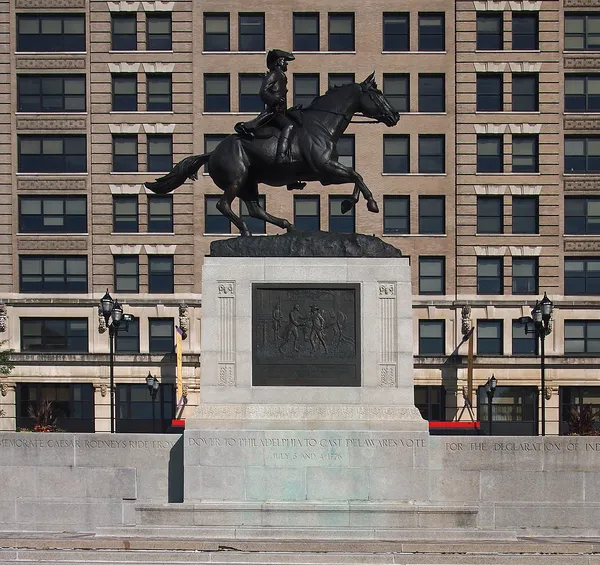
Wilmington’s removed Caesar Rodney statue is set for temporary display at Washington’s Freedom Plaza
A 2020 removal, a 2026 federal display
A bronze equestrian statue of Caesar Rodney—Delaware’s Revolutionary-era political leader and a signer of the Declaration of Independence—is scheduled to be taken from storage and placed on temporary public display in Washington, D.C., at Freedom Plaza on Pennsylvania Avenue NW. The statue had been removed from downtown Wilmington, Delaware, in 2020 amid nationwide demonstrations and municipal reviews of public monuments tied to slavery and racial injustice.
Rodney’s public legacy has long been intertwined with the nation’s founding narrative, while historical records also document his status as an enslaver. In Wilmington, that duality became central to debates over whether prominent civic spaces should continue to feature monuments honoring figures connected to slavery.
How the statue left Wilmington
The monument stood for decades in a central Wilmington public square before city officials ordered its removal in 2020. The decision came during a period when local governments across the United States reassessed statues and memorials associated with the Confederacy, colonial conquest, and other chapters of American history increasingly scrutinized in public life.
Following its removal, the Rodney statue was placed into off-site storage. City government retained ownership, and the statue remained out of public view while Wilmington continued broader discussions over how and where contested monuments should be presented.
What is planned in Washington
The planned Freedom Plaza installation is framed as a temporary exhibit connected to preparations for the United States’ 250th anniversary in 2026. Federal activity around the anniversary has included renewed attention to public symbols of the founding era, alongside ongoing disputes over how to interpret and present the country’s early history—particularly where it intersects with slavery.
The transfer to Washington introduces practical and governance questions that often accompany monument moves: transportation and security arrangements, the duration of the display, and which public entity controls the terms of interpretation on-site. Those details, including the specific timeline for installation and removal, have been treated as administrative planning matters rather than a permanent relocation.
Why the move matters in the national monument debate
The Rodney statue’s reemergence in a high-profile federal space reflects a broader shift in the monument landscape since 2020. In the years after the protests, some removed or damaged memorials have been restored, relocated, or incorporated into curated settings. At the same time, disputes have persisted over whether prominent public sites should foreground commemoration, education, or a combination of both.
The Wilmington removal underscored how local governments can reshape civic memory through monument policy.
The planned Washington display highlights the federal government’s influence over how the founding era is symbolized during major commemorations.
The statue’s dual historical associations—Revolutionary leadership and slaveholding—illustrate the challenges public institutions face when a single monument carries competing civic meanings.
The central question raised by the planned display is not whether Rodney was historically significant, but how that significance is presented when the subject is also tied to slavery.
For Washington, the installation is poised to become another test case in the ongoing national effort to balance commemoration with historical accountability in shared public spaces.