Wilmington’s Removed Caesar Rodney Statue Heads to Washington’s Freedom Plaza for America’s 250th Anniversary Events
A contested monument returns to public view—this time as a temporary federal display
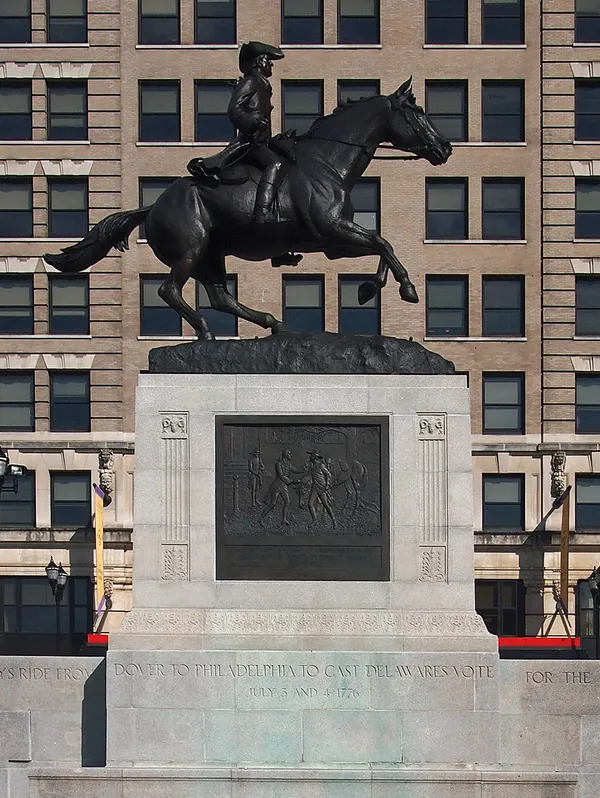
A bronze equestrian statue of Caesar Rodney, removed from downtown Wilmington, Delaware, in 2020 amid nationwide protests over race and public memorials, is set to be temporarily displayed in Washington, D.C., in the run-up to the United States’ 250th anniversary in 2026.
The statue, which had stood for decades in Wilmington’s Rodney Square, was taken down during the period of intense debate and action involving monuments linked to slavery, the Confederacy, and other contested histories. Rodney, a prominent Delaware figure during the Revolutionary era, is also documented to have enslaved people—an aspect of his legacy that became central to arguments over whether the monument should remain in a prominent civic space.
Why the statue was removed in 2020
In Wilmington, the removal occurred as cities across the country faced pressure to reassess public statues during protests following the killing of George Floyd in Minneapolis. Local officials moved the Rodney statue into storage as part of broader deliberations about how—and whether—historical figures with ties to slavery should be represented in shared public spaces.
The Wilmington-area debate over the Rodney statue unfolded alongside decisions involving other monuments in the city, reflecting the wider national pattern in which some statues were removed by government action while others were toppled or vandalized during demonstrations.
Planned display site and the context of the 2026 commemoration
The statue is expected to be installed at Freedom Plaza, a prominent public site on Pennsylvania Avenue NW near the White House. The temporary placement is tied to preparations and programming associated with the national semiquincentennial, a milestone that is prompting cities, states, and federal agencies to organize commemorations, exhibitions, and civic events.
While the display is framed as time-limited, the move places a monument previously removed from a municipal square into one of Washington’s best-known ceremonial corridors—an outcome likely to draw renewed attention to longstanding questions about commemoration, historical context, and the role of public art on federally managed or high-profile civic ground.
What happens after the D.C. display
Plans discussed publicly around the relocation indicate the statue is not expected to return immediately to its prior location in Wilmington’s Rodney Square once the 2026 programming concludes. Instead, the statue’s post-exhibit placement is part of continuing intra-Delaware discussions about where it could be displayed, if at all, and under what interpretive framework.
Key verified facts
- The statue is an equestrian monument of Caesar Rodney formerly displayed in Wilmington’s Rodney Square.
- It was removed from public display in 2020 during the period of nationwide protests and debates over monuments and race.
- The planned temporary display location in Washington is Freedom Plaza on Pennsylvania Avenue NW.
- The move is connected to America’s 250th anniversary commemorations in 2026.
The relocation underscores how disputes over monuments rarely end with removal, often shifting to new questions: where objects should go, what they should signify, and how much context is needed when they re-enter public view.