Where to see cherry blossoms beyond the Tidal Basin across DC, Maryland, and Northern Virginia
Peak bloom timing and why alternatives matter
Washington’s best-known cherry blossom viewing concentrates around the Tidal Basin, where the National Park Service (NPS) defines “peak bloom” as the period when 70% of the area’s Yoshino cherry blossoms are open. For 2026, NPS projected peak bloom for the Tidal Basin and National Mall area between March 29 and April 1, with exact timing dependent on weather conditions. The National Cherry Blossom Festival is scheduled to run from March 20 through April 12.
Those dates help set expectations, but they also draw large crowds into a narrow waterfront corridor. For residents and visitors seeking similar scenery with more room to move, the region offers multiple sites where cherry trees bloom on slightly different schedules depending on variety, microclimate, and exposure.
In the District: larger landscapes and wider variety
U.S. National Arboretum: The Arboretum is a major alternative for cherry viewing, with a broad collection that includes dozens of cherry varieties that do not all bloom at the same time. Its scale and spread-out grounds can reduce the bottleneck effect common along the Tidal Basin.
National Mall and parkland outside the Basin: NPS-managed areas beyond the immediate Tidal Basin shoreline include cherry tree groupings that can provide similar views with different sightlines and pedestrian flow, especially away from the water’s edge.
Neighborhood and street-tree pockets: Local urban forestry efforts maintain cherry trees in parks and along streets in multiple parts of the city, creating smaller “near-home” viewing options that can be reached without navigating the Basin’s heaviest pedestrian concentrations.
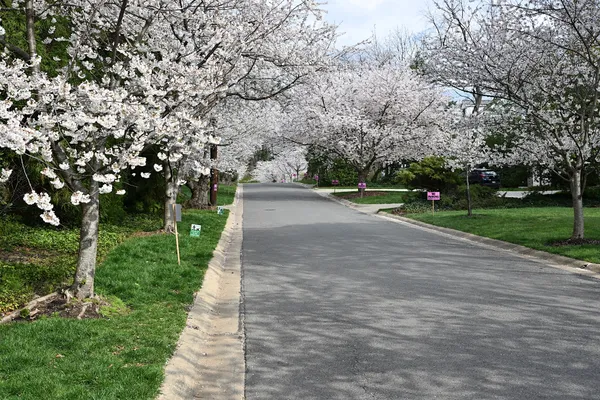
Maryland: Kenwood’s residential canopy
In Montgomery County, the Kenwood neighborhood near Bethesda is widely known for residential streets lined with a large number of Yoshino cherry trees. The Kenwood Garden Club reports that more than 1,200 Yoshino cherry trees were planted in the 1930s and 1940s, producing a concentrated canopy effect across multiple blocks. Because this is a residential area, visitors typically encounter narrow streets, limited parking, and traffic controls during peak weekends.
Northern Virginia: garden settings and campus-like walks
In Northern Virginia, public gardens and park properties can offer structured paths, managed landscaping, and bloom variety. Meadowlark Botanical Gardens in Vienna is among the region’s notable garden settings where cherry trees appear as part of a broader spring display.
Planning note: For a less crowded experience, early-morning and weekday visits generally reduce congestion, while later-blooming varieties—such as many Kwanzan cherries—can extend viewing opportunities beyond the Yoshino peak.
What to watch in the days before you go
Bloom timing can shift quickly with temperature and wind. Visitors planning around the March 29–April 1 window should monitor conditions and consider multiple sites, since peak color can arrive earlier or later depending on location and variety. A flexible itinerary—pairing one high-demand location with at least one alternative—can improve the chances of seeing strong bloom while avoiding the most crowded shoreline paths.