Visitors at Washington’s MLK Memorial mark the holiday with reflection, service, and intergenerational civic lessons
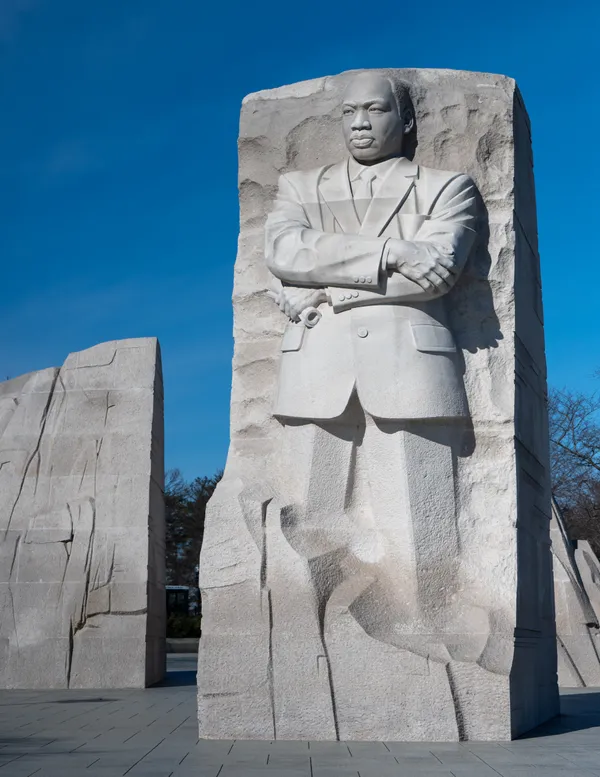
A national memorial built from a defining civil rights speech
On Martin Luther King Jr. Day, observed this year on Monday, January 19, 2026, visitors gathered at the Martin Luther King Jr. Memorial in West Potomac Park, where the site’s design ties directly to King’s 1963 “I Have a Dream” address. The memorial’s central sculpture, the “Stone of Hope,” emerges from the “Mountain of Despair,” reflecting the speech’s imagery and framing the visit as both commemoration and civic prompt.
The memorial opened to the public in August 2011, following a multi-decade effort to establish a national monument honoring King near the National Mall. Its location near the Tidal Basin creates a physical and symbolic line between the Lincoln and Jefferson memorials, echoing the documents King referenced in 1963: the Emancipation Proclamation and the Declaration of Independence.
How the memorial communicates continuity across generations
The memorial’s built elements emphasize a message that does not end with a single historical moment. The “Stone of Hope” is paired with an inscription wall bearing quotations from King’s speeches and writings, presenting themes of justice, democracy, peace, and nonviolence in a setting designed for repeated public return. The National Park Service has also described the sculpture’s intentionally incomplete form as a reminder that King’s work was unfinished and that subsequent generations bear responsibility for continuing it.
That framing resonates on a holiday created through legislative action years after King’s death. President Ronald Reagan signed the bill establishing the federal holiday in 1983, and the first national observance took place on January 20, 1986. Over time, the third Monday in January became a fixed point for Americans to revisit the civil rights era not only as history but as an ongoing civic reference point.
MLK Day as an observance shaped by public life
As a federal holiday, MLK Day changes the rhythm of public institutions and, in many communities, the pace of local gatherings. Many government offices close, and broad participation is often visible across public spaces that serve as national symbols. In Washington, the MLK Memorial’s setting encourages visitors to connect personal remembrance with the broader civic landscape that surrounds it.
What visitors encounter at the MLK Memorial
- The “Mountain of Despair” and the “Stone of Hope,” forming the memorial’s central passage and focal sculpture.
- An inscription wall featuring quotations drawn from King’s public words.
- A site plan aligned with nearby presidential memorials, reinforcing the national scope of the civil rights story.
The memorial’s architecture is built to carry a central idea: that a single leader’s message can become a shared, intergenerational civic obligation.
Across MLK Day observances, the Washington memorial functions less as a static monument than as a recurring public classroom—one that situates King’s legacy in a space where families, students, and visitors can encounter it together, year after year.