Northern lights could be visible near Washington Monday night as severe geomagnetic storm reaches G4 levels
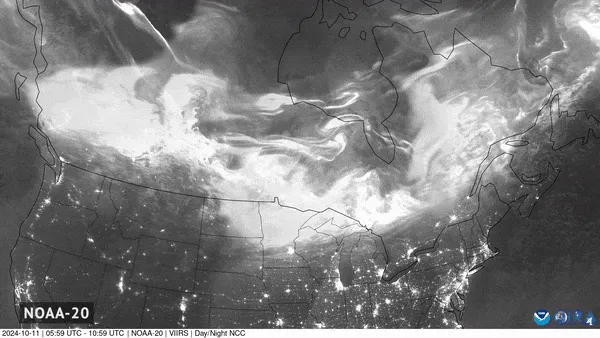
A rare mid-Atlantic viewing chance tied to a strong solar eruption
Residents in the Washington metropolitan area may have an unusual chance to spot the aurora borealis late Monday, January 19, 2026, into early Tuesday, January 20, as a strong geomagnetic storm expands auroral activity farther south than normal.
Federal space-weather monitoring indicated severe storm conditions at the G4 level were reached during Monday afternoon as the shock front from a coronal mass ejection arrived and began disturbing Earth’s magnetic field. Forecasters said elevated storming could continue through the evening, with conditions capable of producing aurora visible at mid-latitudes if skies cooperate.
What is driving the event
The storm follows an X-class solar flare on Sunday, January 18, that launched a coronal mass ejection toward Earth. When the CME’s magnetic field interacts strongly with Earth’s magnetosphere, charged particles can be guided toward the poles and collide with upper-atmosphere gases, producing the green, red, and purple glow known as the northern lights.
Storm intensity is tracked on a five-step scale from G1 (minor) to G5 (extreme). A G4 event is uncommon and can push the auroral oval equatorward, increasing the odds of sightings well outside the usual northern-tier states.
What Washington-area observers can realistically expect
In the District and surrounding Maryland and Virginia suburbs, any aurora is most likely to appear low on the northern horizon rather than overhead. Visibility can shift quickly because auroral strength depends not only on the storm category but on the orientation of the interplanetary magnetic field and bursts of solar wind energy.
Local light pollution is a major limiting factor. Even during strong events, aurora at this latitude may be faint to the naked eye. Cameras and smartphone sensors—especially with night modes or long exposures—often reveal color and structure that are difficult to see in real time.
When to look and how to improve chances
Watch windows: late evening Monday through the pre-dawn hours Tuesday, when geomagnetic activity can peak in pulses.
Direction: face north with a clear, unobstructed horizon.
Location: seek darker areas away from stadium lighting, commercial corridors, and dense neighborhoods.
Photography: use a tripod if available; try several multi-second exposures and recheck the sky periodically.
Aurora forecasts for mid-latitude cities remain conditional: strong geomagnetic activity can occur without a visible display locally, while brief surges can create short-lived viewing opportunities.
Beyond skywatching: operational impacts
Severe geomagnetic storms can affect technology and infrastructure, including satellite operations and radio communications, and may degrade some navigation signals. Monitoring continues as the CME passes, with the strongest impacts typically occurring during periods of rapid magnetic-field change.