Investigators cite systemic gaps, controller workload, and helicopter altitude errors in deadly Potomac midair collision
Final findings outline layered failures preceding Jan. 29, 2025 crash near Reagan National
Federal investigators have concluded that a series of systemic and operational breakdowns set the conditions for the Jan. 29, 2025 midair collision over the Potomac River near Ronald Reagan Washington National Airport that killed 67 people.
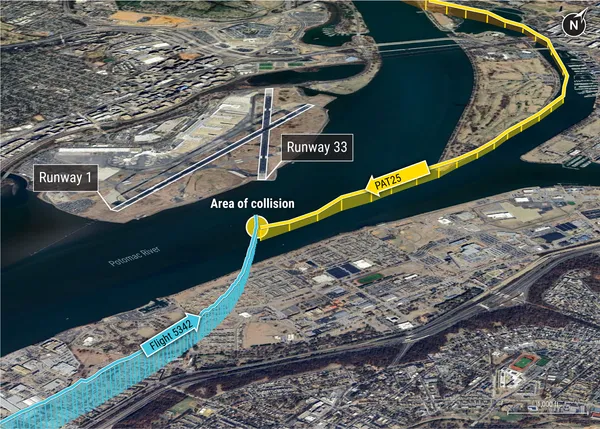
The crash occurred at about 8:48 p.m. Eastern time when a U.S. Army Sikorsky UH-60L Black Hawk helicopter, operating under the callsign PAT25, collided with American Airlines Flight 5342, a CRJ700 regional jet operated by PSA Airlines. The collision happened roughly a half mile southeast of the airport, and both aircraft fell into the Potomac River. All 64 people aboard the airliner and all three crew members aboard the helicopter died.
Probable cause: route placement, limited review, and reliance on visual separation
Investigators determined the probable cause centered on the placement of a helicopter route in close proximity to a runway approach path, combined with a failure to regularly review helicopter routes and act on prior internal warnings and available safety data. The final conclusions also identified an air traffic system that relied heavily on visual separation to maintain traffic flow, without adequately accounting for the limitations of “see-and-avoid” at low altitude, at night, and in complex airspace.
The helicopter crew’s inability to apply effective visual separation was cited as an additional causal element in the collision sequence.
Controller workload and situational awareness losses
Investigators found that tower staffing and workload conditions contributed to degraded performance. The tower team lost situational awareness during a period of elevated complexity, after the helicopter and local control positions were combined under high workload. The investigation concluded that the absence of a real-time risk assessment process contributed to misprioritization of duties, incomplete traffic advisories, and the lack of safety alerts to both flight crews.
Radio communications practices were also highlighted, including risks created when helicopters and airplanes operate on separate frequencies and when blocked transmissions prevent critical instructions from being fully received.
Altitude exceedance factors and technology limits
The final findings attributed a key role to the Army’s failure to ensure its pilots fully understood error tolerances on barometric altimeters, which investigators said contributed to the helicopter flying above the maximum published route altitude. The investigation also concluded that neither aircraft carried collision avoidance technology capable of providing effective warning in the low-altitude environment where the crash occurred.
While the jet’s traffic alert and collision avoidance system functioned as designed, investigators found that system inhibit limits at low altitude reduced the likelihood of higher-level alerts that could have prompted immediate evasive action.
Scope of recommendations
Investigators approved dozens of findings and issued wide-ranging safety recommendations focused on changes in helicopter route design, air traffic control procedures and training, safety management systems, data sharing, and collision avoidance technology. The recommendations include revisions intended to create clearer separation between helicopter routes and fixed-wing approach paths, improve tower risk-management tools, and expand traffic-awareness capabilities in cockpits operating in high-density airspace.
- Crash date/time: Jan. 29, 2025, about 8:48 p.m. ET
- Location: Potomac River, about 0.5 mile southeast of Reagan National
- Aircraft: UH-60L Black Hawk (U.S. Army) and CRJ700 regional jet (PSA Airlines operating as Flight 5342)
- Fatalities: 67 (no survivors)
The investigation concluded that long-standing safety gaps in route design, oversight, workload management, and low-altitude alerting defenses combined to create conditions in which a single conflict escalated into a fatal collision.