How Washington’s 1922 Knickerbocker Storm Led to a Deadly Theater Roof Collapse in Adams Morgan
A record snowstorm and a catastrophic structural failure
On January 28, 1922, Washington was in the grip of what remains the city’s largest official snowstorm on record: 28 inches fell over roughly two days, paralyzing streets, transit and basic services. That Saturday night, the storm’s impact turned fatal inside the Knickerbocker Theatre, a major movie house at 18th Street and Columbia Road NW in the neighborhood now widely known as Adams Morgan.
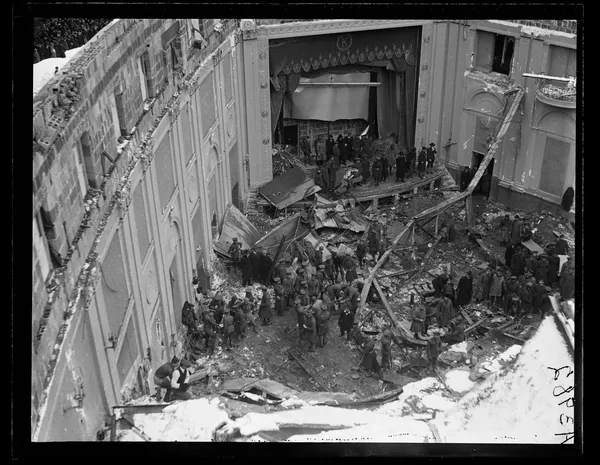
During an evening screening of the silent film Get-Rich-Quick Wallingford, the theater’s flat roof failed under the load of accumulated snow. The roof collapsed into the auditorium, striking the balcony; the balcony then gave way into the seating below. The disaster killed 98 people and injured 133, making it the deadliest single-day incident in District history.
What happened inside the auditorium
Accounts from the time describe little obvious warning until moments before the collapse. Survivors reported a sharp hissing or tearing sound overhead, followed by dust and falling plaster as the ceiling began to crack. The failure occurred shortly after 9 p.m. and unfolded in seconds, leaving many patrons trapped under heavy debris of plaster, steel and masonry.
Emergency response converged quickly. Police, firefighters, soldiers and volunteers worked through the night in severe weather conditions to pull survivors from the wreckage and transport the injured to area hospitals. Among those killed was former U.S. Representative Andrew Jackson Barchfeld.
Investigations and disputed liability
Multiple investigations followed, focusing on why the structure failed so abruptly. The findings centered on the roof’s support system and the way loads were transferred to the building’s walls. Engineering analyses concluded that the collapse most likely stemmed from design and structural-support deficiencies rather than a single defective piece of steel, including evidence that a critical bearing condition at the wall allowed a main element to slip out of position under extraordinary weight.
Despite the scale of the tragedy, later civil claims did not produce a definitive legal allocation of responsibility. Courts struggled to determine liability among the parties involved in the theater’s construction and operation.
The Knickerbocker site and the storm’s place in Washington’s weather history
The Knickerbocker Theatre had opened only a few years earlier, in 1917, and was considered a prominent entertainment venue of its era. It was later rebuilt as the Ambassador Theater; decades afterward, urban redevelopment reshaped the corridor and removed the later structure.
Today, the event remains closely tied to Washington’s extreme-weather record and to enduring lessons in building safety. The 1922 blizzard is still cited as the District’s benchmark snowfall event, and the collapse stands as a reminder that weather emergencies can expose hidden vulnerabilities in the built environment.
- Date of collapse: January 28, 1922
- Location: 18th Street and Columbia Road NW
- Casualties: 98 dead, 133 injured
- Storm total: 28 inches (largest official single-storm snowfall for Washington)
In a city immobilized by record snow, a routine Saturday night at the movies became a mass-casualty disaster within moments.