How President Trump’s First Year Reshaped Washington’s Federal Workforce, Symbolic Landscape, and White House Interior
A first-year imprint across institutions and public space
During President Donald Trump’s first year back in the White House, changes in Washington have been most visible in three arenas: the organization of the federal workforce, the physical and symbolic treatment of monuments and historic sites, and the interior presentation of the executive mansion itself. Together, those moves have blended administrative restructuring with high-profile signals about governance and national memory.
Federal workforce: hiring limits and reclassification efforts
Early workforce actions were structured around restricting growth in federal employment and increasing managerial leverage over certain roles. The administration put forward an approach combining a hiring freeze at the outset of the term, followed by longer-term limits designed to reduce headcount through attrition while permitting exceptions for national security and public safety functions.
In parallel, the administration advanced a new employment classification framework aimed at positions considered policy-influencing. Under that approach, a defined subset of career roles could be moved into a category with reduced procedural protections and fewer avenues for appeal in disciplinary actions. The stated objective was faster accountability mechanisms in policy-adjacent jobs, while preserving standard civil-service protections for most operational positions.
- Initial hiring restrictions were framed as a mechanism to curb workforce expansion and force agency-by-agency prioritization.
- Subsequent plans focused on attrition-based reductions combined with targeted exemptions.
- Proposed classification changes concentrated on roles described as policy-determining, policy-advocating, or confidential.
Monuments and memory: restoration decisions revive long-running conflicts
Washington’s monument landscape has also been a focal point. Federal action to restore or reinstall contested historical displays has renewed debates that long predate the current term, particularly around Confederate-linked memorials in the capital region. One of the most closely watched examples has been the effort to return the statue of Albert Pike—toppled and burned during 2020 racial justice protests—to a prominent downtown site.
The reinstatement has unfolded as a practical undertaking—restoration work, reinstallation planning, and security considerations—while also functioning as a political and cultural flashpoint. Supporters describe restoration as preservation and continuity in federal stewardship. Critics argue that placement in civic space confers honor and that controversial monuments belong in museums or contextualized settings.
In Washington, decisions about what remains on pedestals often become proxies for broader arguments over how the nation narrates its past.
The White House interior: curated symbols and a redesigned visual message
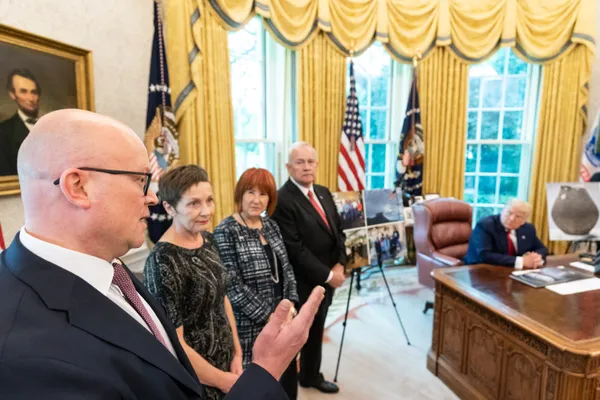
No location has served as a more concentrated stage for visible change than the White House itself. The Oval Office and surrounding spaces have been reworked through new artwork and prominent historical displays, including presidential portraits and a replica of foundational documents. Such alterations are common across administrations, but their specific selections can be read as a deliberate statement about continuity, legitimacy, and the presidency’s relationship to the country’s founding narrative.
What the first-year changes add up to
Across personnel policy, public monuments, and the White House’s presentation, the administration’s first-year imprint in Washington has combined structural levers with highly legible symbols. The cumulative effect has been to make governance changes visible not only through regulations and staffing decisions, but also through what residents and visitors can see—inside the presidency’s most recognizable office and across the capital’s most contested public spaces.