How Defense Contractors Came to Dominate Washington’s Transit Advertising and What Metro Rules Allow
A commuter landscape shaped by federal contracting
Across Washington and nearby Northern Virginia, riders have increasingly encountered advertising dominated by defense contractors and firms competing for Pentagon and federal agency work. Concentrations have been especially visible at stations that serve the defense and national security workforce, including the Pentagon station in Arlington and Capitol Hill-adjacent stops used by congressional staff.
The dynamic reflects the Washington region’s unusual marketplace: a dense cluster of government decision-makers, acquisition professionals, and contractors who rely on federal budgets. Transit advertising offers a way to reach this audience repeatedly, at predictable times, in spaces where commuters move through corridors, escalators, mezzanines, and platform areas.
How “station domination” works
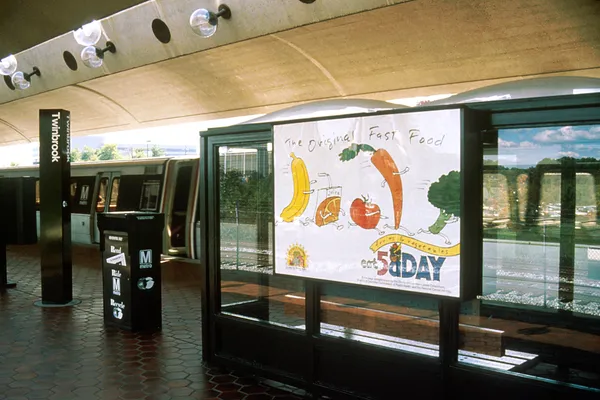
Washington Metropolitan Area Transit Authority (WMATA) sells advertising across rail stations, trains, and buses through a contracted advertising operator. Within that inventory, packages can allow a single advertiser to occupy much of the available space in a station for a limited period, a practice commonly described in the out-of-home advertising industry as a station “domination.” In practical terms, this can mean walls, banners, and other placements carrying one brand’s messaging simultaneously, creating a unified campaign rather than scattered posters.
Campaigns tied to defense-sector calendars can intensify the effect. For example, the Association of the United States Army’s annual meeting—held at the Walter E. Washington Convention Center—draws tens of thousands of attendees and hundreds of exhibitors, with dates publicly listed for October 14–16, 2024 and October 13–15, 2025. The convention center is directly served by the Mt Vernon Square station, making that corridor attractive for advertisers seeking to reach conference traffic.
WMATA’s policy line: commercial advertising vs. public-policy persuasion
WMATA operates under “Guidelines Governing Commercial Advertising” that restrict certain categories of messages. Among the prohibited types are ads intended to influence the public on issues with varying opinions and ads intended to influence public policy. The guidelines were adopted as part of WMATA’s effort to limit issue-oriented advertising, and they have been tested repeatedly in litigation over rejected ads involving advocacy, religion, and political controversy.
At the same time, defense-industry advertising frequently uses language and imagery tied to military programs, procurement priorities, or technological capabilities. That creates an ongoing compliance question: where to draw the boundary between promoting a company’s services and attempting to influence government policy or purchasing decisions.
Why the ads cluster where they do
Audience concentration: Pentagon-area stations serve Defense Department personnel, contractors, and related commuters.
Procurement ecosystem: Washington is the center of federal budgeting and contracting, making repeated brand impressions strategically valuable.
Event-driven surges: Major defense conferences and Hill activity can coincide with short, intensive campaigns near key stations.
WMATA’s advertising rules prohibit messages intended to influence public policy, while its system remains one of the region’s most efficient channels to reach federal decision-makers.
What remains unresolved
The visibility of defense-industry campaigns in transit spaces continues to raise operational and legal questions about how WMATA’s commercial advertising framework is applied in practice—particularly when messaging is tailored to government audiences. As long as transit advertising remains a prime channel for reaching the federal workforce, the tension between revenue, permissible commercial speech, and prohibited issue advocacy is likely to persist.